 CHILI PIPER // 2026 WEB CONVERSION BENCHMARK
2026 Web Conversion Benchmark
Mid-market companies book 36 of every 100 form submissions, and the largest performance gap appears at the booking step. Here's the leak, and what closes it.
July 2025 through June 2026 · Mid-market means companies with 100 to 2,500 employees · Funnel rates are volume-weighted · Company benchmarks are account-weighted · Figures are rounded
The benchmark shows where mid-market companies lose meetings and which booking experiences are associated with better results.
Qualification does not guarantee a meeting
do not book a meeting. 62 complete the booking.
About 57 of every 100 form submissions qualify and reach the booking step. Within that qualified group, 62% book a meeting and 38% do not complete the booking.
Gaining the 38 buyers back
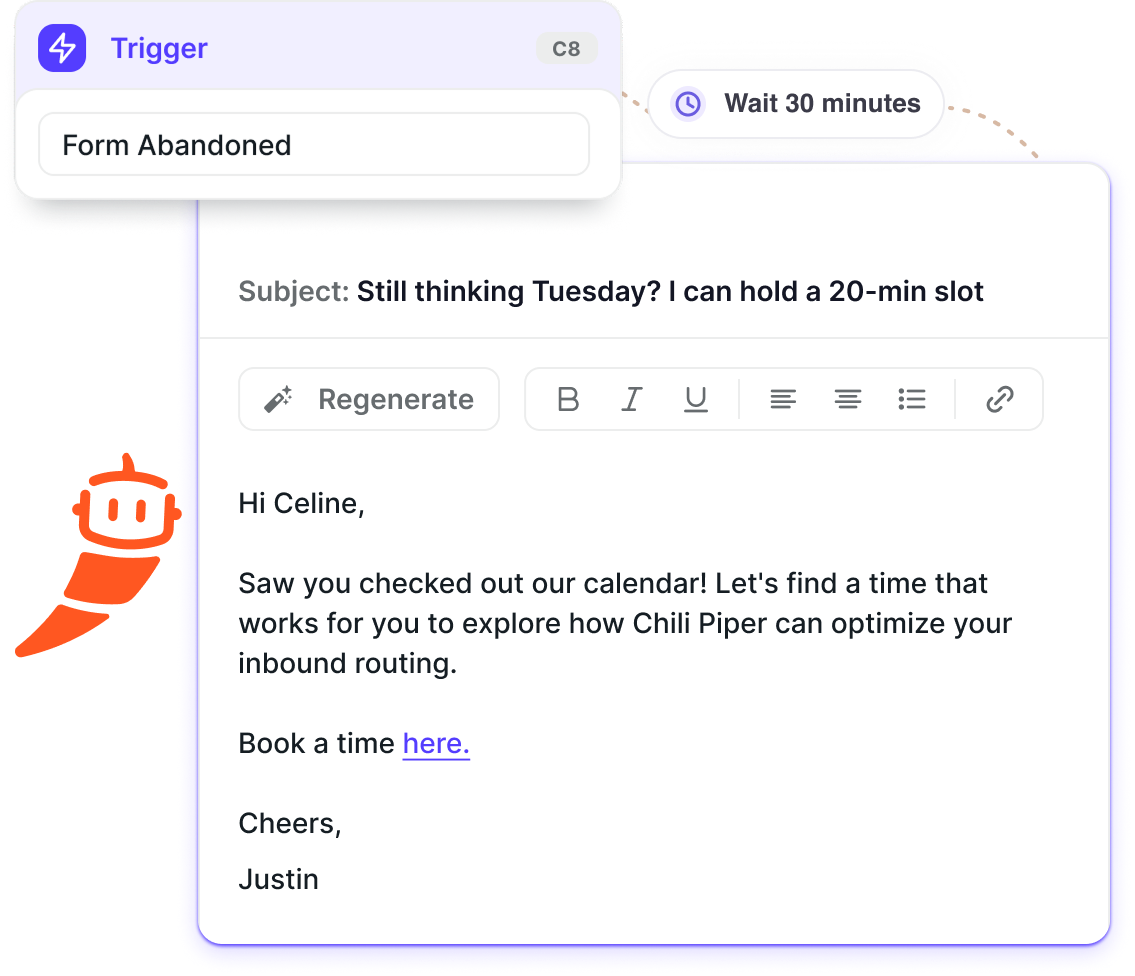
Here's the encouraging part: these 38 buyers already qualified and entered the booking flow. Some don't find a time that works; others just need a nudge. Inviting them back to a live scheduler the same day, while their interest is still warm, is the most direct path to more mid-market pipeline. That's the job Chili Piper's Orchestrator is built for: getting more meetings from traffic you already paid for, instead of buying more.
Re-engagement happens outside the measured form funnel, so this benchmark does not show how many buyers return. It does show that qualified buyers who leave before booking are the largest opportunity in the funnel.
Now compare your overall form-to-meeting rate
The chart above looks only at qualified submissions. This benchmark returns to all form submissions, including those screened out, and shows how many meetings companies book for every 100 forms.
More open times book 4x more meetings
This is the biggest change you can make, and the simplest. When a buyer qualifies, they see a scheduler. What matters is whose availability they see.
Show the combined open times of every rep who could take the meeting, and 76% of routed form submissions book. Send the qualified buyer to one rep's availability instead, and only 18% book. More available times make it easier for buyers to find one that works.
same leads
Instant-call companies book more meetings
Some companies let qualified buyers start a live call immediately instead of scheduling for later. Companies offering this option convert about 38 of every 100 form submissions into meetings, compared with 35 of every 100 at companies offering scheduling only.
This is an observed comparison, not a controlled test. Treat it as a strong pattern rather than proof that the live-call option caused the difference.
How the 10 most represented industries in our dataset convert
Each row follows the same journey: form submission, qualification, booking, then meeting speed. Company benchmarks are account-weighted, and the percentages use different starting groups, so read them from left to right.
Qualification varies by industry.
About 75% of Infrastructure & Dev Tools and IT & Security submissions qualify. Data & Analytics and Travel, Hospitality & Wellness sit below 70%.
Booking rates stay close.
Once buyers qualify, most industries book between 53% and 58%. HR Software is slightly higher at 60%.
Meeting speed varies more.
About 50% of Manufacturing meetings are set for the same or next day. Marketing Software, Legal & Compliance, and Data & Analytics sit closer to 33%.
Booked while you slept
40% of mid-market meetings are booked outside business hours in the buyer's own timezone, including 14% on weekends.
They book fast, too: about 50% of meetings are set for the same or next day, and 90% happen within a week.
Your booking flow needs to work without a sales rep being present. Interested buyers should be able to qualify and schedule a meeting at any hour.
- During business hours 60%
- Weeknights, after hours 26%
- Weekends 14%
Based on the 12 most common buyer timezones, covering roughly 70% of booked meetings.
These meetings were booked outside the buyer's business hours. By the next morning, they were already on the schedule.
Booking peaks from 10 to 11 a.m. in the buyer's timezone, and Tuesday is the busiest day. Even so, 40% of meetings are booked outside business hours.
Chat creates another entry point into your funnel
Forms capture only one part of website demand. Across 81,017 mid-market chat sessions from April through June 2026, 17.6% shared an email address and 2.6% booked a meeting through chat.
Chat gives visitors who are not ready to book a meeting an opportunity to start a relationship with your company and get their questions answered. Shared email addresses create an opportunity for follow-up, helping your team capture more of the demand that's already on your site.
Start with 1,000 chat sessions. Applying the mid-market chat booking rate and illustrative industry benchmarks shows how those conversations can translate into potential pipeline.
The 2.6% booking rate comes from this benchmark. The 38% appointment-to-opportunity rate comes from OpenView’s Sales Benchmarks Report. The $40,000 average contract value is an illustrative mid-market benchmark from The Digital Bloom’s 2025 B2B SaaS benchmark synthesis. Actual conversion rates and contract values vary by company.
The pipeline is already on your website
More traffic is not the only path to more pipeline. Mid-market websites already attract qualified buyers, but too many leave before they book. Shared availabilities, instant-call options, booking that works at any hour, and chat each remove a different dead end. Together, they turn more of the demand you already have into meetings.
Compare three numbers from your website with these benchmarks:
- Typical company's form-to-meeting rate 42%
- Booking rate when buyers see shared availability 76%
- Qualified buyers who reach booking but leave 38%
What we counted, exactly
Benchmarks are only as good as their definitions. Here are ours.
- Form submission
- A completed website form connected to a booking flow.
- Qualified
- A form submission that passed the company's qualification rules and continued to the booking step.
- Form-to-meeting conversion
- Booked meetings divided by total form submissions.
- Qualified-to-booked rate
- Booked meetings divided by qualified form submissions.
- Abandoned
- A qualified form submission that reached the booking step but did not become a booked meeting.
- Volume-weighted
- Every form submission counts equally, so companies with more submissions have more influence on the result. The overall funnel uses this method.
- Account-weighted
- Each company has equal influence on the benchmark, regardless of how many form submissions it receives.
- Time to meeting
- The time between booking and the scheduled meeting, measured in days. It shows when buyers choose to meet, not how quickly a sales rep responds.
- After hours
- Outside Monday to Friday, 8am to 6pm, in the buyer's own timezone. Weekends count as after hours. The analysis covers the 12 most common buyer timezones, representing roughly 70% of booked meetings.
- Instant call
- An option that lets a qualified buyer start a live call immediately instead of scheduling a meeting for later.
- Routing methods
- How the system decides whose availability a qualified buyer sees. Flexible round robin shows the combined open times of every eligible rep. Strict round robin assigns one rep and shows only that person's availability.
- Chat session
- A website session in which a visitor interacted with chat. Chat was measured separately from forms from April through June 2026.
- Observational data
- Comparisons observed across live companies, not controlled experiments. Treat them as strong patterns, not proof that one setup caused the result.
Ready to plug the leak?
Book a call and we'll walk your funnel against these benchmarks, then show you how Chili Piper wins back the qualified buyers who never book.