// AI Inbound SDR
The AI SDR that actually works
No persona, no avatar, no digital-worker theater. Every form fill, chat, and demo request qualified, routed, and booked on the right rep's calendar — while your prospect is still on the page.
The secret sauce behind high-performing GTM teams at
// Why it matters
The market's right: most AI SDRs don't work
That verdict was earned by outbound — AI-written cold email at volume, avatars with human names, pipeline made of promises. Inbound is a different job. Your buyers are already raising their hands; the only way to fail them is to make them wait. That's the part we automate, and the part we'll demo live on your own forms.
What is an AI inbound SDR?
An AI inbound SDR is software that does the job an inbound sales development rep used to do: respond to inbound interest instantly, qualify the lead against your ideal customer profile, get the meeting booked with the right rep, and make sure the follow-up happens when the prospect drops off. The bar for the category is set by four requirements — instant response to form fills, demo requests, and chat; dynamic qualification rather than a scripted decision tree; CRM integration deep enough to carry transcripts and lead context; and contextual follow-up when a visitor leaves without booking.
The 'inbound' matters. Most of the skepticism about AI SDRs comes from outbound — AI-written cold emails at volume. Inbound is a different job: the buyer has already raised a hand, and the machine's role is to remove every second and every handoff between that hand-raise and a booked meeting.
A role, or a system?
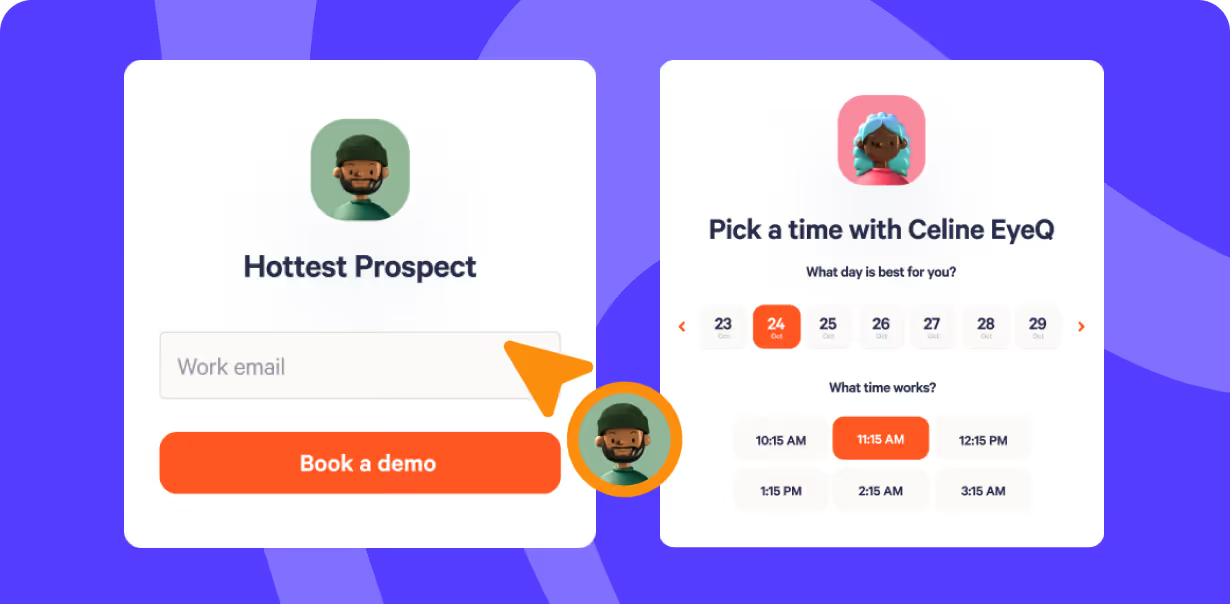
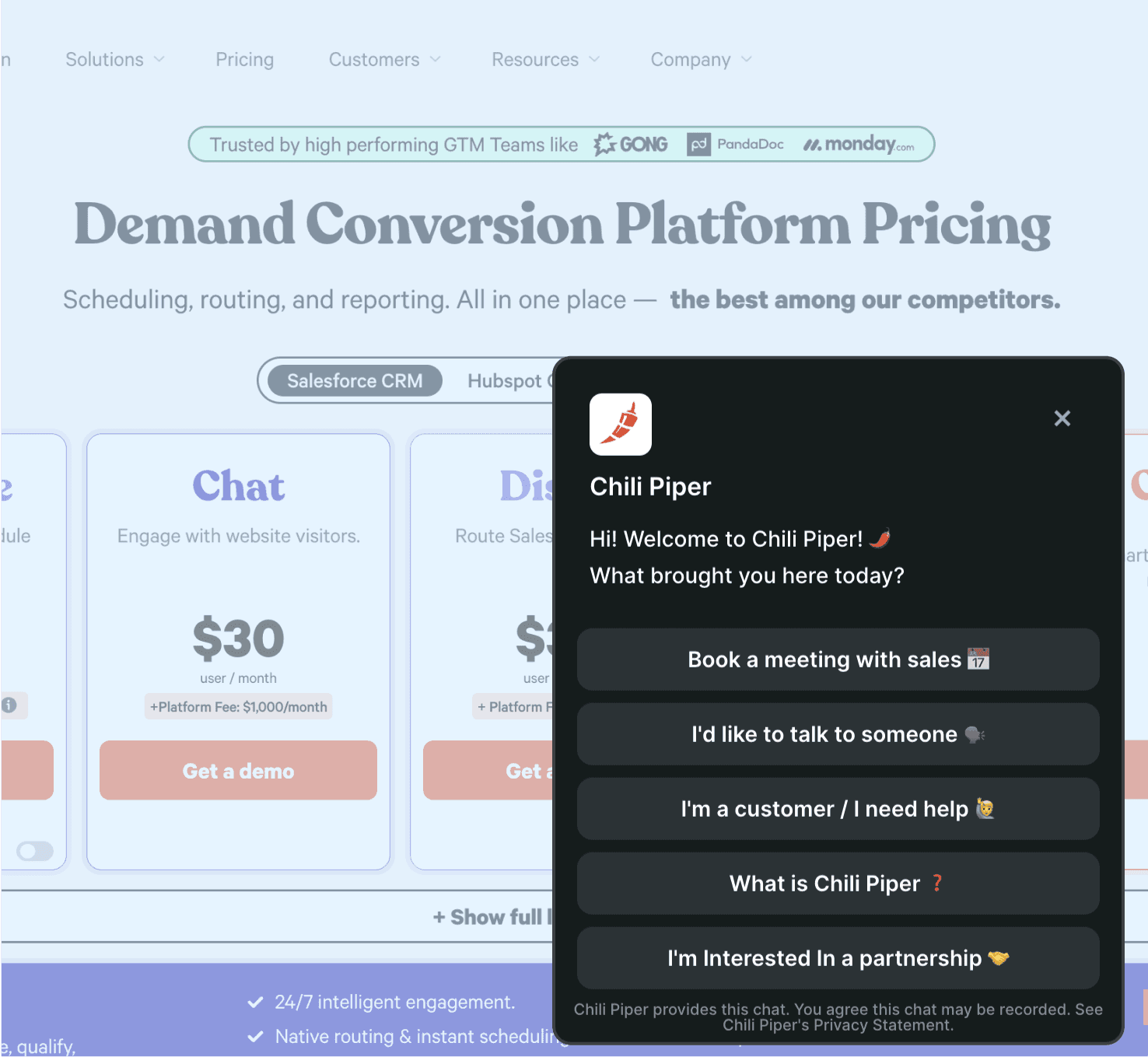
Most vendors sell the role as a single closed agent — one product that chats, qualifies, books, and follows up entirely inside its own walls. Chili Piper's answer is a composed system: Concierge turns form fills into booked meetings in the session, Chat AI qualifies conversationally against your ICP, Orchestrator triggers the downstream action, and Email Composer drafts the follow-up it triggers.
The difference shows up after the demo. A closed agent duplicates what you already own — another place rules live, another place to check. A composed system reaches into the stack you already run: your CRM, your sequencer, your Slack. It works with your stack, not instead of it.
Don't buy routing twice
The category's own definitions include 'routes to the right rep' as a core requirement of an AI inbound SDR. Yet most agents in the category can't do it — which is why teams running them typically buy separate routing software alongside. That's two contracts, two rule engines, and a seam in the middle of your funnel where leads leak.
Chili Piper started as the routing and scheduling layer for revenue teams. Territory rules, account ownership, weighted round-robin with no-show calibration, multi-location scheduling, and rep-to-rep handoff are native to the same platform the AI agents run on. The mix isn't a compromise between two tools — the mix is the product.
// How it works
How the AI Inbound SDR works
A lead raises a hand
Form fill, demo request, or website chat — the moment intent shows up, the agent responds in the same session. No queue, no 'someone will reach out'.
Qualified and routed in the session
Conversational qualification against your ICP, backed by enrichment your prospect never has to type. Routing runs on the rules you already use — territory, ownership, round-robin with calibration.
Booked, handed off, followed up
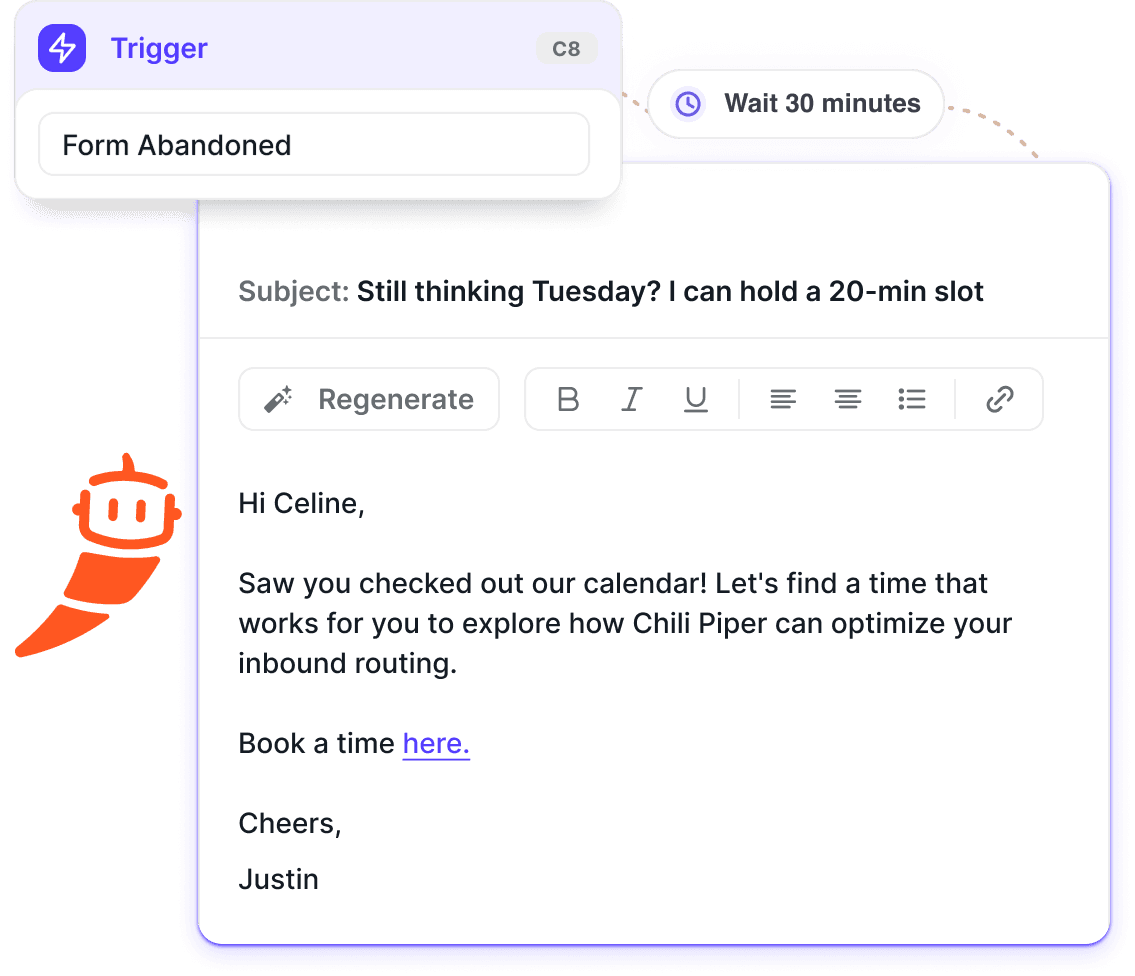
Qualified prospects book on the right rep's calendar on the spot. If they drop off, Orchestrator triggers the follow-up through the tools you already run — with Email Composer drafting it.
// The checklist
What to require from an AI Inbound SDR
Whoever writes the requirements list wins the evaluation. Here's ours — including the lines where we'll tell you straight that we're not the strongest answer.
01
Respond in seconds, on every channel
Forms, demo requests, and chat should get a response in the session — not a confirmation email and a wait. Speed to lead is the reason this category exists.
02
Qualify dynamically against your ICP
A real conversation informed by CRM data and enrichment — not a rigid decision tree that asks questions your systems can already answer.
03
Route natively — don't buy routing twice
Most AI SDR agents can't route, so teams pair them with separate routing software. Require territory rules, account ownership, and calibrated round-robin in the same product.
04
Book with real scheduling depth
Multi-location teams, group meetings, weighted distribution, no-show calibration. A booking link is not scheduling infrastructure.
05
Hand off between reps without friction
When an SDR books for an AE — or a deal moves teams — the meeting should land on the right calendar with full context, not restart the thread.
06
Write everything back to the CRM
Meetings, reschedules, transcripts, and qualification context — created and updated automatically, so reporting doesn't depend on rep discipline.
07
Work with your stack, not instead of it
Downstream action should run through the tools you already own — your sequencer, your CRM, your Slack — not inside one vendor's walled garden.
08
Demo the whole loop, live
Hand-raise to booked meeting, on your forms and your rules — live, not in a video. Anything a vendor can't demo today is roadmap, whatever the deck says. We hold ourselves to the same rule.
And where to press every vendor — including us
09
Contact-level visitor identification
We show you which accounts are on your site. Naming the individual visitor isn't something we lead on today — ask every vendor what's shipped versus roadmap, and ask to see it live.
10
Sustained multi-touch nurture
Our agents draft the follow-up and trigger it through your existing tools. If you want the SDR itself running long nurture sequences from a rep's inbox, we're not the strongest answer today.
11
A face, a name, a voice
No avatar, no fake human name, no uncanny-valley video rep. If a mascot matters to your evaluation, that's not us — we'd rather the meeting show up than the mascot.

The hottest GTM teams run on Chili Piper
Your logo belongs here



“70% lift in demo request form conversions. 5x increase in the number of demo requests. Frictionless buyer experience.”

Noa Farber
Director of Marketing AutomationGong








Common questions
What is an AI inbound SDR?
An AI inbound SDR is software that does the inbound sales development job: it responds to form fills, demo requests, and chat instantly, qualifies the lead against your ideal customer profile, routes it to the right rep, books the meeting, and makes sure follow-up happens if the prospect drops off. It handles inbound interest — buyers who already raised a hand — which is a different job from AI-written outbound prospecting.
How is this different from a chatbot?
Chatbots walk visitors through a scripted decision tree and end with a form or a link. An AI inbound SDR holds a real conversation, qualifies against your ICP using CRM data and enrichment the visitor never has to type, and finishes the job — a qualified, routed, booked meeting on the right rep's calendar, written back to your CRM.
Does it replace our SDR team?
It replaces the parts of the job that punish humans for being human: responding within seconds at 2am, checking routing rules, finding mutual availability, chasing no-shows. Teams typically redeploy SDRs to work that actually needs judgment — outbound, ABM plays, and the conversations that don't fit a rule.
Can it send follow-up emails for us?
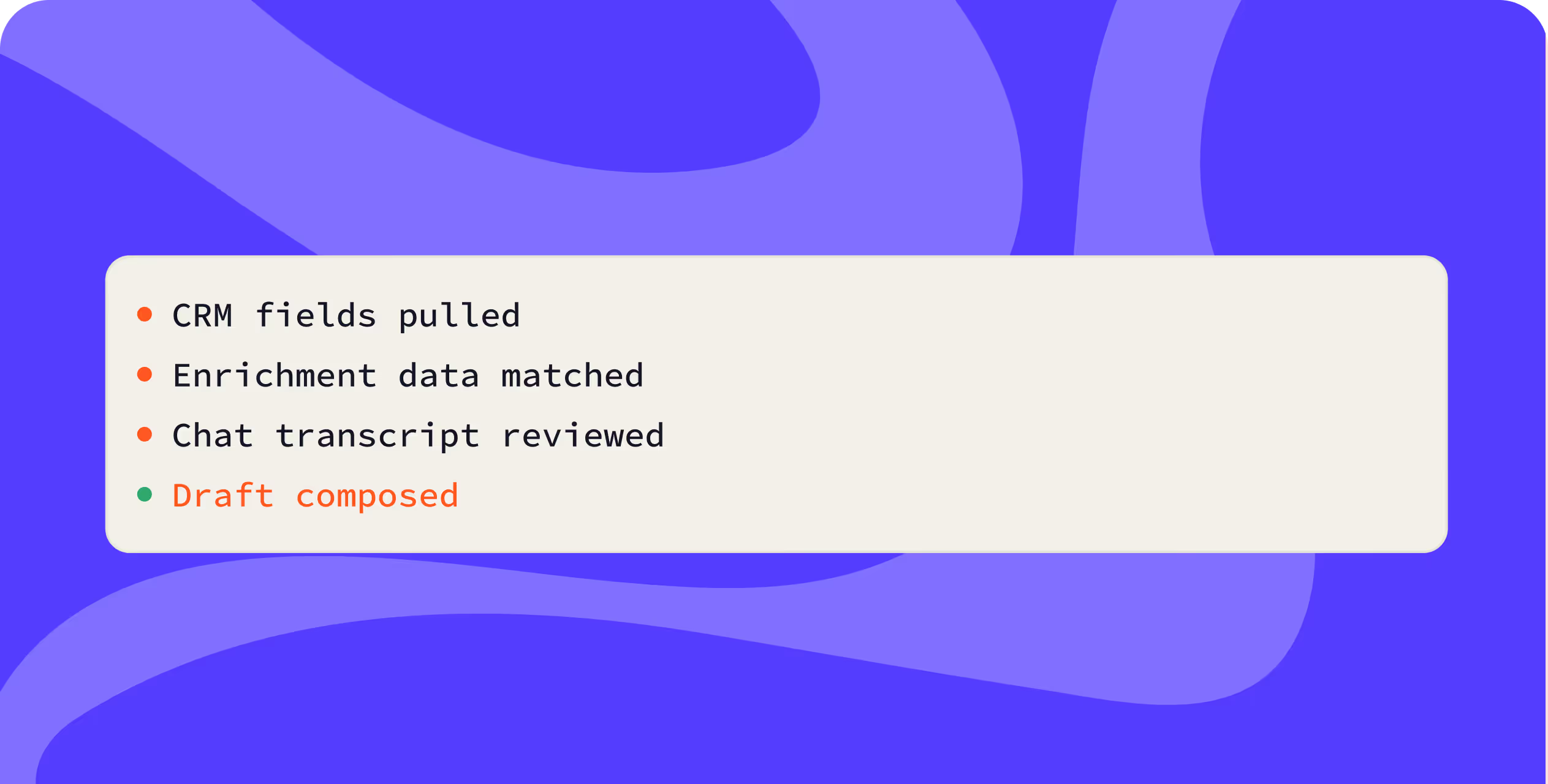
Email Composer drafts the follow-up — personalized from CRM data, enrichment, and the chat history, with the exact booking link your routing rules would have chosen — and Orchestrator triggers it through the email and sequencing tools you already run. We deliberately don't bolt on a shadow email system; the send happens in your stack, where your deliverability, compliance, and reporting already live.
Does it identify anonymous website visitors?
At the account level, yes — Account Identification shows you which companies are on your site, and Web Experiences can engage qualified accounts before they fill a form. We don't currently lead on naming the individual anonymous visitor; if contact-level identification is central to your evaluation, ask every vendor to demo it live on your own traffic.
Do we still need separate lead routing software?
No — and this is the sharpest difference in the category. Most AI SDR agents can't route, so teams buy routing software alongside them. Chili Piper's routing is native: territory rules, account ownership, weighted round-robin with calibration, and rep-to-rep handoff run in the same platform as the AI agents, so there's no seam between qualifying a lead and getting it to the right calendar.