A practical guide to SDR leadership and modern outbound sales strategy
In February 2025, I transitioned from an individual contributor SDR role to leading an outbound sales motion responsible for nearly 20% of our net new business.
At a time when outbound is declared "dead," SDR teams are being replaced with AI, and outbound motions are being cut, this role forced me to reconsider SDR leadership, outbound sales strategy, and revenue predictability.
No pressure.
This post isn't an invitation to watch a new manager "learn leadership lessons." It's a practical look at SDR leadership inside a revenue-critical outbound sales team.
It's an invitation to step away from tired narratives—"AI will kill SDRs", "Outbound is dead", "Cold calling should be illegal"—and examine a human-led outbound operation that actually generates revenue.
Our SDR team ended 2025 at 118% of goal for closed-won. Here, we focus on the metric that matters most: Revenue. This demonstrates how a human SDR team can still source revenue at scale.
I'm sharing this because outbound isn't dying. Inefficient outbound is.
When outbound breaks, the impact extends beyond philosophy; it becomes a forecasting problem, a customer acquisition cost problem, and eventually a revenue problem.
This post provides a transparent breakdown of what succeeded, what failed, and what I learned while running a 10-year-old outbound engine, all while building the plane mid-flight, occasionally upside down.
What You'll Find in This Post
- A brutally honest evaluation of a mature outbound operation that is always pivoting and growing
- The biggest wins and quiet mistakes of 2025
- How we restructured onboarding and weekly enablement to reduce ramp time
- Why pipeline equality matters more than star reps, and how we enforced it
- How we used our own product (Distro) to automate account distribution by tier
- Our pivot from an email-heavy motion to a true hybrid approach using calls (yes, ironic… especially after we said in 2024 that cold calling was on life support)
- Where we're placing our bets for outbound in 2026
- And the occasionally comic perspective of a first-time leader learning, in real time, that leadership is less about answers and more about clarity, focus, and consistency.
A Candid Evaluation of Our Outbound Motion
When I stepped into the role, one of my first conversations was with Maria, our Director of Business Development.
I told her:
"If there's one thing I want to prioritize for the year, it's rep efficiency."
Nothing is more painful than watching colleagues invest massive activity and see very little return.
Coming from the SDR role myself, it was painful to watch reps sending 200+ emails a day, actively working 600-700 accounts per month, and still not consistently hitting quota.
The effort was there.
The time was there.
The output, sometimes… wasn't.
That was our first real signal: this wasn't a motivation problem, it was an operational one.
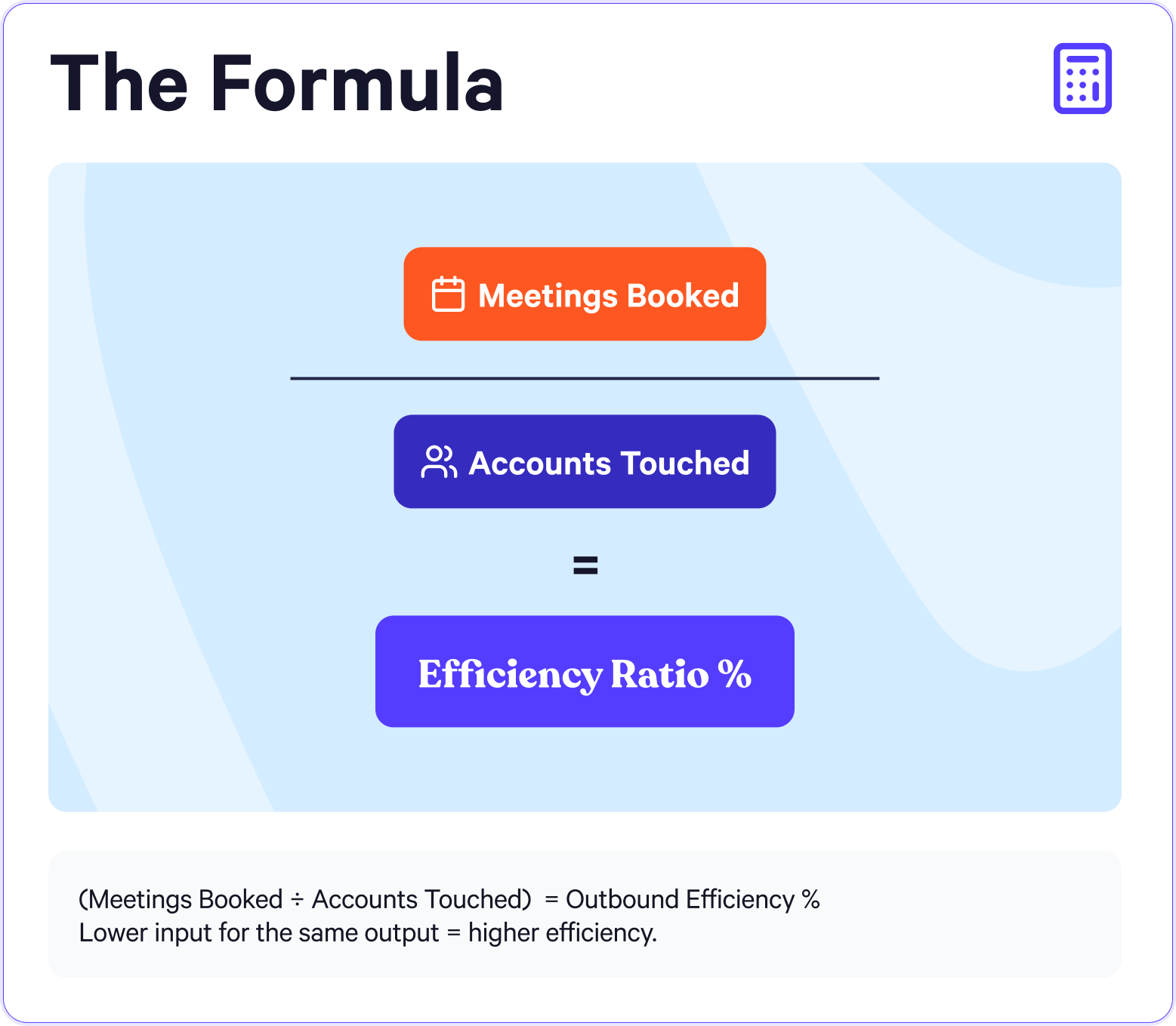
Efficiency became our lens to evaluate everything. And we did this by making sure it was not just a buzzword.
Step 1: Data-Driven Clarity (Showing the Math, Not the Opinion)
We started with a basic question: What does efficiency actually mean in outbound?
Instead of opinions, we showed the team the math:
- How many accounts each SDR was actively working on
- How many of those accounts ever turned into pipeline
- Where time and energy were being spent versus where results were coming from
These weren't easy conversations. We were explicit with the team:
The rules of the game are changing, and pretending otherwise helps no one.
Every SDR, regardless of tenure, went through training on:
- Pipeline organization
- Account prioritization
- Channel optimization
Efficiency stopped being an abstract concept. It became a shared language, present in weekly meetings, 1:1s, and performance conversations throughout the year.
Step 2: Support (Teaching Reps How to Diagnose Themselves)
Talking about efficiency itself wouldn't cut it. The team knew they should focus on efficiency. But how? Not every rep immediately knew how to improve their own efficiency.
We redesigned our 1:1s and team meetings to focus on:
- Helping SDRs understand their own efficiency signals
- Teaching them how to diagnose a bad month early
- Spotting patterns before results fully dropped
We needed SDRs to become operators of their own pipeline, because leadership attention had to be split between coaching people and fixing the systems around them.
Step 3: Equitable Account Distribution
"You do not rise to the level of your goals. You fall to the level of your systems." James Clear - Atomic Habits
I'm currently re-reading Atomic Habits, and this phrase resonated deeply during 2025. Chili Piper has very ambitious goals, and we knew we had to match our systems to those aspirations.
During H1, I ran a deeper analysis and found a major red flag: SDR pipelines were not equitable.
Tenured reps consistently had access to accounts that booked more. New SDRs didn't. Besides creating very strong and negative feelings in new SDRs, it also created operational gaps:
- Slower ramp times
- Higher frustration
- Wasted effort on low-conversion accounts
We were already using account tiers to reflect proximity to our ICP in our CRM, and help reps find accounts faster. The data confirmed something important:
Higher-tier accounts were fewer in volume but significantly higher in booking rates.
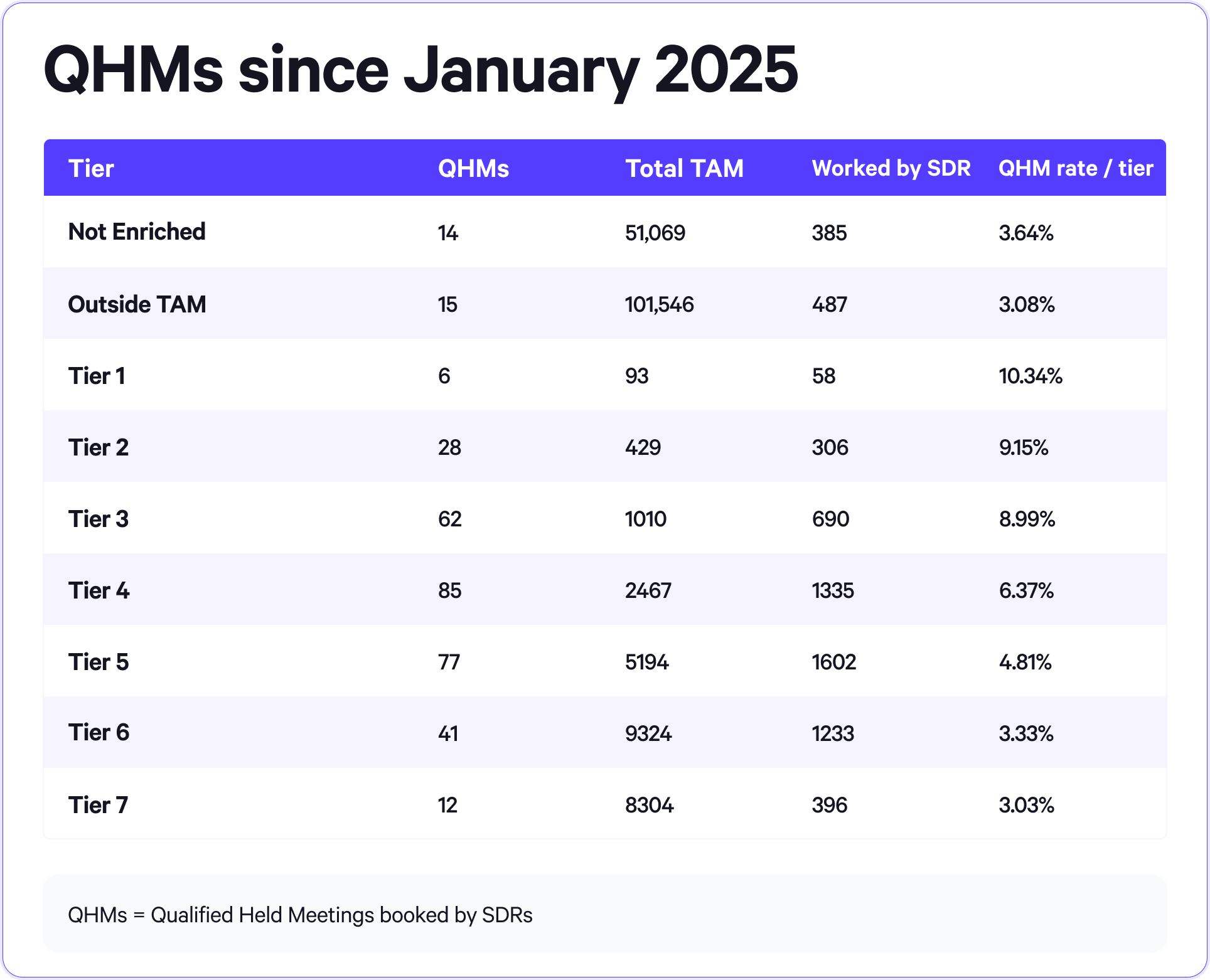
The conclusion was unavoidable: If SDRs don't have balanced pipelines, they don't have equal chances to succeed and we won't build a healthy team with equal chances to be efficient.
We shifted focus to:
- Rebalancing pipelines across the team
- Giving all SDRs access to higher-quality accounts
- Reducing time spent digging through pools of low-conversion prospects
This change alone:
- Reduced ramp time for new SDRs
- Increased focus and care per account
- Improved overall efficiency without increasing workload
Efficiency didn't come from asking reps to do more activities. It came from finally making sure they were working on the right things.
The Biggest Wins and the Quiet Mistakes of 2025
By mid-year, one thing was clear: efficiency alone wouldn't get us where we wanted to go.
We had cleaned up pipelines. We had clarified priorities. We had made effort more intentional.
But we were still operating inside a constraint we hadn't fully acknowledged yet: we were optimizing too heavily for one channel: Emails.
Win #1: Onboarding Became More Intentional
One of the earliest shifts we made was how we thought about onboarding. Previously, onboarding was focused on completion: finish the content, shadow a few calls, start prospecting.
What we needed instead was confidence + signal. We restructured onboarding and weekly enablement to:
- Narrow focus in the first months (fewer skills, done better)
- Make expectations explicit by day and week, not month. Reps were getting lost in their priorities, with their eyes on the prize of booking meetings. We structured their routines around what they should carry as focus in their roles going forward
- Tie enablement directly to real pipeline work, not simulations
Result:
- Faster time-to-first-meeting
- Earlier performance signals
- Less emotional volatility during ramp
Win #2: Enforcing Pipeline Equality (Even When It Was Uncomfortable)
One of the most impactful, and initially controversial, decisions we made was enforcing pipeline equality.
For a long time, our best accounts naturally gravitated toward our most tenured reps. It felt logical. It also created a silent ceiling for everyone else.
We made a deliberate choice: Pipeline quality would no longer be a reward for tenure. This meant that every SDR would have access to accounts that could convert.
What changed:
- New SDRs ramped faster because they weren't stuck prospecting low-conversion pools
- Tenured reps became more intentional with the accounts in their pipeline, instead of trying to only add more accounts every day, they were intentionally trying to convert the ones in their pipeline
- Coaching conversations became about skill, not fairness
Quiet Mistake: Believing Perfect Emails Would Take Us Further
Here's one we don't talk about enough. For a long time, we believed that if we just kept improving our emails—better copy, better personalization, better cadences—results would follow.
I was preaching that! My cadences usually got me to quota every month… Email did work. But it plateaued.
We were optimizing inside a ceiling without admitting it. What happened? Focusing exclusively on email:
- Limited speed to pipeline
- Reduced rep growth because they were stuck in one channel
- Made performance more sensitive to external noise
The quiet mistake wasn't email itself. It was believing that perfection in one channel would replace balance and constant optimization across channels.
Our biggest mindset change was simple: We stopped optimizing for replies and started optimizing for conversations.
A reply doesn't mean much if it doesn't move anything forward. A conversation, regardless of the channel, is the strongest signal that we're pacing toward our goals.
That conversation can come from:
- An email reply that isn't a polite "no" (or a rejection)
- A LinkedIn exchange that actually progresses
- A phone pickup that lasts more than 2 minutes
At Chili Piper, reps who consistently perform are not the ones sending the most emails. They're the ones averaging at least two real conversations per day.
That metric became a north star for us, because conversations compound learning, confidence, and pipeline in a way volume alone never will.
Win #3: Pivoting to a Hybrid Motion
Eventually, we made the call to implement a dialer and lean into a hybrid outbound motion. Four years ago, when I joined Chili Piper, this was not at all our focus.
We had excellent results coming from email-only strategies.
What surprised us most?
We started seeing pipeline within the first two months, even before formal call training rolled out. That was a signal.
Calls didn't replace email. They complemented it. Calls reintroduced faster feedback loops, higher intent conversations and better qualification earlier in the process.
Win #4: Using Our Own Product to Remove Human Friction
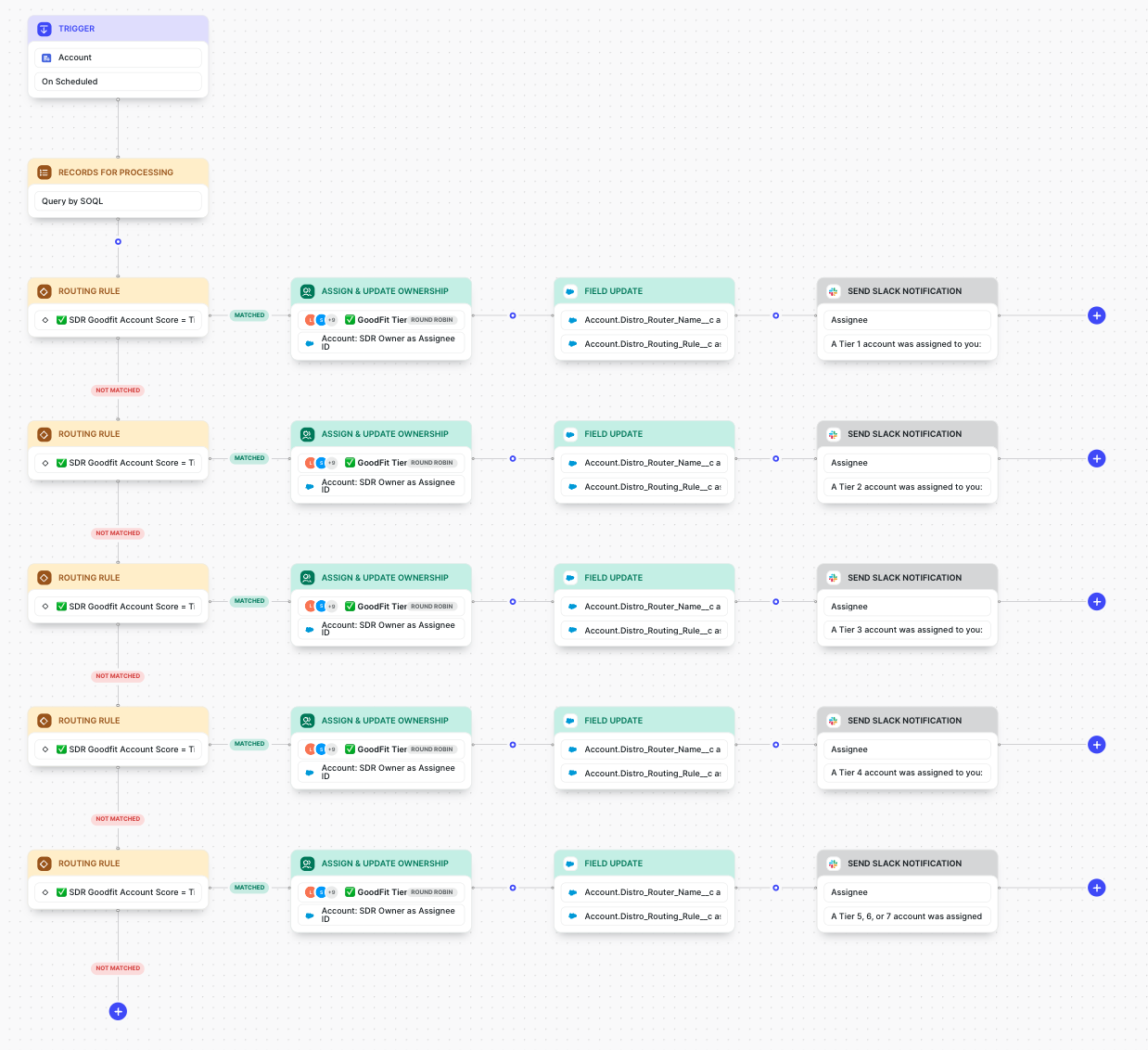
As our motion became more complex, manual distribution became a liability. Reps were still fighting to find the best accounts in time, and these were quickly becoming a bottleneck for our pipeline equality.
We leaned into our own product (Distro) to:
- Automate account distribution based on tier
- Prioritize top tier accounts distribution in an equitable manner
- Maintain fairness in pipelines by delivering top tiered accounts every day, while also giving reps time back to focus on other revenue generating activities
Our main goal was to help reps trust the system they were operating inside.
Where We're Placing Our Bets for Outbound in 2026
2025 taught us an important lesson: efficiency alone isn't the finish line. We are focused on building an Outbound operation that is relevant, scalable, and revenue-predictable. In 2026 we are betting on focus over volume, depth over coverage, and conversations over clicks.
1. Helping SDRs Work Smarter, Not Harder
Our first bet is on prioritization powered by signal. Instead of asking SDRs to "do more," or forcing AI into every move we take, we're investing in:
- Clear signals that indicate who to focus on
- Earlier identification of accounts worth deeper effort
- Reducing time spent on low-probability activity
The goal is simple: better decisions earlier in the day.
2. Smaller Pipelines, Stronger Revenue Specialists
Our pipelines are intentionally getting smaller, and more powerful. Even with fewer accounts, we are generating almost double the revenue.
We want SDRs to become revenue specialists inside their own pipeline, not volume operators across hundreds of accounts.
That means:
- Knowing the companies they're reaching out to
- Presenting themselves clearly as Demand Automation specialists
- Protecting prospect and rep time, making every outreach feel relevant, not automated
Time is no longer spent spraying the same cadence across dozens of accounts. It's spent creating real connections that compound into pipeline.
3. A Tier-Based Strategy That Shapes Daily Routines
Not all accounts deserve the same approach, and in 2026, we're formalizing that reality.
We're defining different engagement strategies by tier and clear expectations for touch depth and cadence per tier. This will help SDRs structure their day with intention.
Tiering stops being just a segmentation tool and becomes a daily operating system.
4. Improving Our Calling Motion With Data and AI
Calls are no longer a "talent-only" skill. We use AI to understand what actually converts, identify gaps in our call approach, and design training based on real patterns that can become clear examples.
The goal is simple: understand what works and replicate it across the team. When SDRs see the data behind it, the results are clear, and the old call resistance diminishes.
5. Coaching and Training
Enablement in 2026 isn't about more sessions, it's about better ones. We want to create those "A-há" moments for the SDRs. We're investing in:
- Coaching that builds confidence, not confusion
- External perspectives that challenge our assumptions
- Continuous improvement of our team routines
The goal isn't to overload SDRs with information, but to create clarity they can act on.
One example: we invested in an in-person coaching session, followed by ongoing 1:1s, focused entirely on trust-building.
The intent was simple: help SDRs understand how to create trust in real sales conversations. Because we believe outbound works best when it's about finding common ground and establishing trust, even when the conversation starts cold… and yes, even if we're calling you on a Friday.
6. READMEs and Playbooks That Preserve Learning
Since I joined Chili Piper, I noticed that lack of knowledge was never the problem. Everyone seemed to be doing a solid process… by themselves. Things evolved quickly and were not properly documented. Experiments happened. Decisions were made. And over time, we forgot why we did what we did.
In 2026, we're fixing that by:
- Documenting experiments and their outcomes
- Deciding on owners for every part of our process
- Defining clear playbooks accessible to everyone
This creates continuity, accelerates learning, and prevents us from constantly reinventing the wheel.
7. Building a Culture of Quality Conversations
Our final, and most important, bet is on quality conversations. We're moving away from one-size-fits-all channel expectations and instead identifying which channels work best for each rep and coaching them to master that channel, turning it into their personal revenue engine.
At the end of the day, outbound performance doesn't come from volume. It comes from conversations that matter, repeated consistently.
Closing Reflection
The deepest lesson I took from 2025 is this: reps can work incredibly hard, but effort alone will only take us part of the way toward our goals.
The progress that helped us surpass our revenue targets didn't come from a new tool, channel, automation, or AI. It came from creating the right conditions. We are transparent about what works and what doesn't, and honest when things need to change.
That clarity builds trust, which fosters a culture where we can make meaningful adjustments together, instead of pushing harder in the wrong direction.
This is the kind of environment where people perform, grow, and GLOW! And creating this environment is one of my biggest goals as a leader.