Your "Book a Demo" button is asking for trust you haven't earned yet
Picture a buyer who's done their research. They've read the G2 reviews, compared three competitors, and skimmed your pricing page. They're genuinely curious, maybe even close to ready. They hit "Book a Demo."
A form appears. Name, email, company, role, team size, use case. Then a calendar. Then: "Someone will be in touch shortly."
They close the tab.
Not because they weren't interested. Because you asked for too much before you gave them anything.
The commitment you're asking for
"Book a Demo" is a significant ask. You're requesting 30 minutes of someone's calendar, their contact information, and their tolerance for a sales follow-up sequence, before showing them a single thing.
This made sense once. When SaaS was new, the demo was the product reveal. Buyers needed a guided tour to understand what the software even did. That buyer doesn't exist anymore. Today's buyer has already watched the explainer video, read three case studies, and compared your pricing to two alternatives. They don't need orientation. They need a reason to believe before they hand over their time.
The form isn't the problem. The order of operations is.
And that order has a cost. B2B SaaS companies take an average of two days to respond to a demo request. 35% never respond at all. Chili Piper was built to close that gap, to make sure that when someone shows intent, the response is instant, the routing is right, and the meeting gets booked before the window closes. That problem is largely solved for teams running a modern demand conversion stack.
But there's a gap before the gap. What happens before the form, whether the buyer has any context, any investment, any reason to show up and determines the quality of everything that follows.
The argument: product first, commitment second
A prospect who has spent 10 minutes exploring your product before booking a meeting is a fundamentally different person from one who hasn't.
They're more qualified. They've self-selected on relevance. They've already had at least one moment where something clicked — where they thought this might actually work for us. When they show up to the meeting, the first 10 minutes of orientation are already done. They're asking real questions, not basic ones.
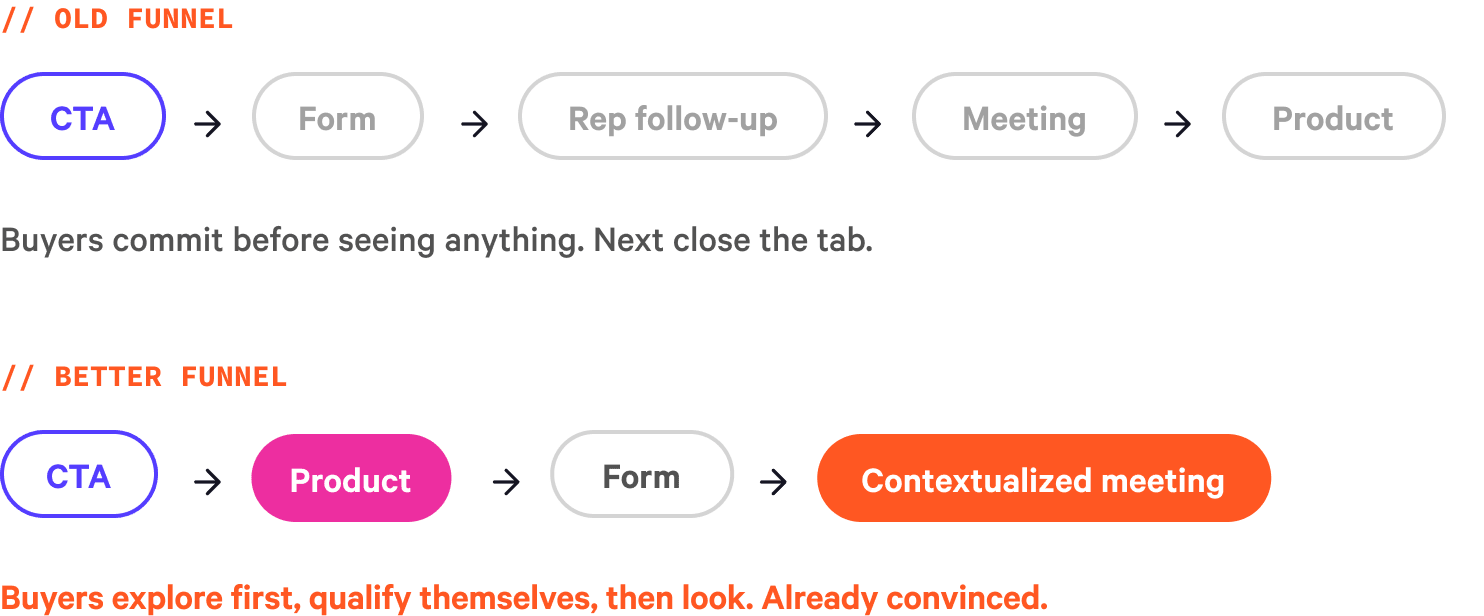
This is the reordering most demand gen teams haven't made yet:
"The leads who experience the product before booking aren't just more qualified — they're fundamentally different buyers. A cold form fill intent is to learn, but a post-storylane demo booking has buy intent. That gap is where most of the sales cycle lives, and closing it starts with letting buyers self-educate on their own terms."
— Nalin Senthamil, Co-founder & CEO, Storylane
The evidence
ContactMonkey's team tested this directly. They replaced a mix of live webinars and high-maintenance demo videos with a single gated interactive Storylane product demo and built an automated conversion system around it.
When someone submitted the demo gate form, Chili Piper's routing logic qualified the lead against their ICP and immediately assigned it to a SDR via round robin — with a Slack alert and an automatic CRM update. Matching leads got a meeting. Non-ICP leads went to nurture. No manual triage, no queue.
The results:
Form conversion went from 11% to 15% after removing friction.
28% lead-to-opportunity rate — double the rate of other inbound sources.
$1.6M in pipeline attributed directly to the interactive demo.
The 28% is the number worth sitting with. That's not a conversion rate optimization win. That's a lead quality win. Prospects who explored the product before booking were twice as likely to become opportunities as prospects who came in through any other inbound channel.
Once those numbers came in, the goal was to protect the setup:
"Almost 30% of the leads that come through our gated form end up becoming an opportunity. It's scary to change that."
— Tara Robertson, Director of Marketing, ContactMonkey
What this looks like in practice
The mechanics are straightforward. A prospect lands on your site and instead of (or alongside) a standard demo request CTA, they're invited to explore the product. They move at their own pace. When they hit a moment of genuine interest — a feature that solves their actual problem — a scheduling prompt appears. They book without leaving the experience. No new tab, no separate form, no friction.
By the time the meeting starts, the rep already knows what they explored. The CRM is updated. The context is there before anyone says hello.
Three embed points worth knowing about:
- A persistent booking link in the header (always visible, low pressure)
- A fixed CTA at the bottom right (triggered at peak interest)
- A mid-demo modal that appears right after a key aha moment.
- The last one is the most underused and often the most effective. Timing the ask to the moment the product just proved its own value.
"With Storylane, we can see exactly where in a demo a buyer's behavior shifts — when they slow down, replay a step, or click a CTA. That's the intent signal."
— Nalin Senthamil, Co-founder & CEO, Storylane
And because this sits inside a full demand conversion system, the loop closes even when someone doesn't book in the demo. If they abandon the form, miss the follow-up, or go quiet after a no-show, Orchestrator catches those signals and fires the right re-engagement: through Salesloft, Outreach, Gong Engage, or Slack, depending on what your team already uses. The lead doesn't disappear. The system picks it back up.
The play that works after the first call too
This logic doesn't stop at inbound. It applies to every discovery call your reps walk out of.
Most follow-ups look like this: a recap email, a one-pager, maybe a case study. Generic. Easy to ignore. Easy to forget to forward to the CFO.
The better move: send a personalized product demo tailored to exactly what the prospect said they cared about on the call — ending with a booking link. The champion can forward it. Their VP of Sales can explore it on their own time and book directly. Every stakeholder who engages traces back to the rep who sent it.
This is how deals go multi-threaded without another introduction call. The product does the selling. The link closes the loop.
What actually changes
This isn't an argument to remove your demo request form. It's an argument to stop treating it as the first thing you ask for.
The "Book a Demo" button has been the default B2B CTA for twenty years because there was no better option. Now there is. Let buyers explore. Let them qualify themselves. Let them arrive at the form already having decided they want the meeting, not wondering if it's worth their time.
Your website shouldn't be a passive brochure with a calendar link at the end. The best demand conversion systems treat the site as an active pipeline engine: identifying who's on it, engaging them based on who they are, and converting the ones who are ready, before they raise their hand, not after.
The "Book a Demo" button doesn't need to die. It just shouldn't be the first thing you ask for.
Learn more about the Chili Piper + Storylane integration.